There's a particular moment I watch for at every bilingual wedding. It's when a grandmother who has been sitting politely, following the shape of the ceremony but not the words, suddenly leans forward — because the ceremony has switched into her language and she is in it. That moment is the entire reason this service exists.
The problem with a one-language wedding
Most couples I meet are marrying across a language line. One set of parents is comfortable in English; the other set follows some of it. Grandparents, aunts, uncles who flew in for the week — for them, a ceremony delivered entirely in English is something they attend rather than something they experience.
The usual fix is a relative standing beside the celebrant translating as they go. I understand the instinct, but it rarely works. It doubles the length, kills every joke, flattens the emotional beats, and puts a family member under pressure on a day they should be enjoying. Nobody's grandmother wants a subtitle track. She wants the ceremony.
How a bilingual ceremony actually works
A ceremony built properly in two languages is not the same ceremony said twice. It's written from the start to move between languages, so each part lands once and lands well.
- We map the room firstBefore I write a word, we work out who is actually in front of us. Which side needs which language, who the key elders are, whether anyone will struggle. The structure follows from that, not from a template.
- Each section gets a home languageThe welcome might open in Punjabi, the story of how you met run in English, the blessing from grandparents entirely in Hindi. Guests aren't waiting through a translation — they're being spoken to directly, in turn.
- The emotional beats carry in bothVows, the ring exchange, the pronouncement: these are said in both languages by design, because nobody should miss them. The rest flows.
- The legal words stay in EnglishThe Marriage Act sets out specific wording that has to be spoken. It's short, it's in English, and I frame it so it doesn't break the spell.
The result runs to a normal ceremony length — usually twenty to thirty minutes — rather than the fifty minutes a line-by-line translation would take.
A bilingual ceremony isn't two ceremonies stitched together. It's one ceremony that happens to breathe in two languages.
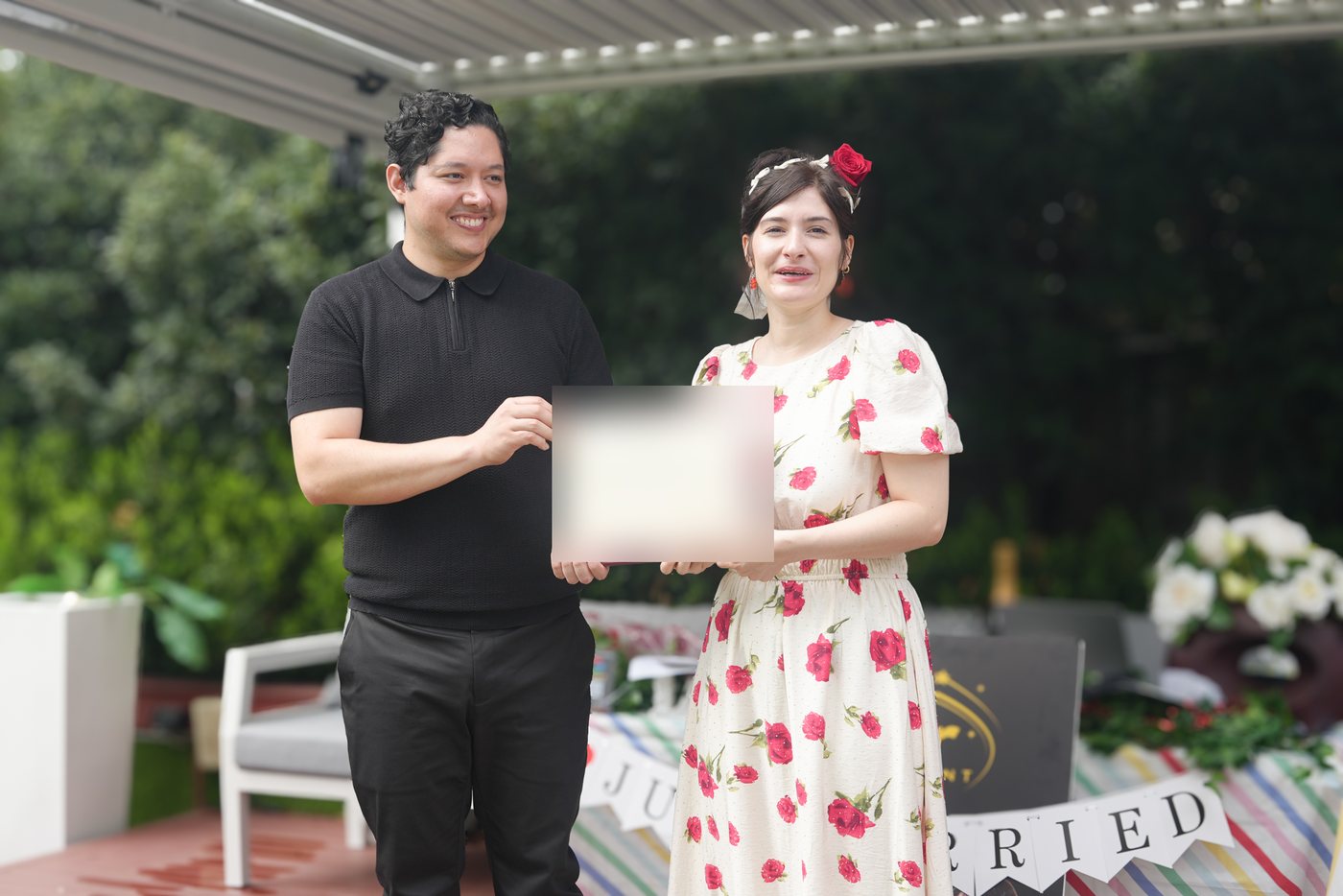
For a real example, Manon and Karim each learned to speak their vows in the other's language — she in Spanish for his Mexican family, he in French for her parents — at their garden wedding in Sydney, with both families following live by video from overseas.
Why it helps that I'm not reading phonetically
Hindi and Punjabi aren't a party trick for me. I spent years as editor of the Indian Herald and The Indian, two of Sydney's South Asian newspapers, and worked as a voiceover artist with SBS Radio and a presenter at Indian Link Radio. Language is the thing I did for a living before I ever stood at the front of a wedding.
Practically, that means I'm not sounding out transliterated lines from a script. I can hear when a phrase is landing flat and change it, take a joke in Punjabi and let it breathe, and adjust register for a room of elders rather than a room of cousins. That flexibility on the day is most of the value.
What's included, and what costs extra
Ceremonies conducted in English, Hindi and Punjabi are part of my standard packages at no additional cost — these are my own languages, not an add-on I outsource. Delivering ceremony elements in another language, such as Mandarin, Arabic or Greek, is arranged in advance and available from $200.
Who this is usually for
The most common bookings are Indian and Indian-Australian weddings, Sikh couples whose legal ceremony sits alongside an Anand Karaj, and Punjabi families marrying into Anglo-Australian ones. But it's just as often a couple where neither is South Asian and one family simply isn't confident in English.
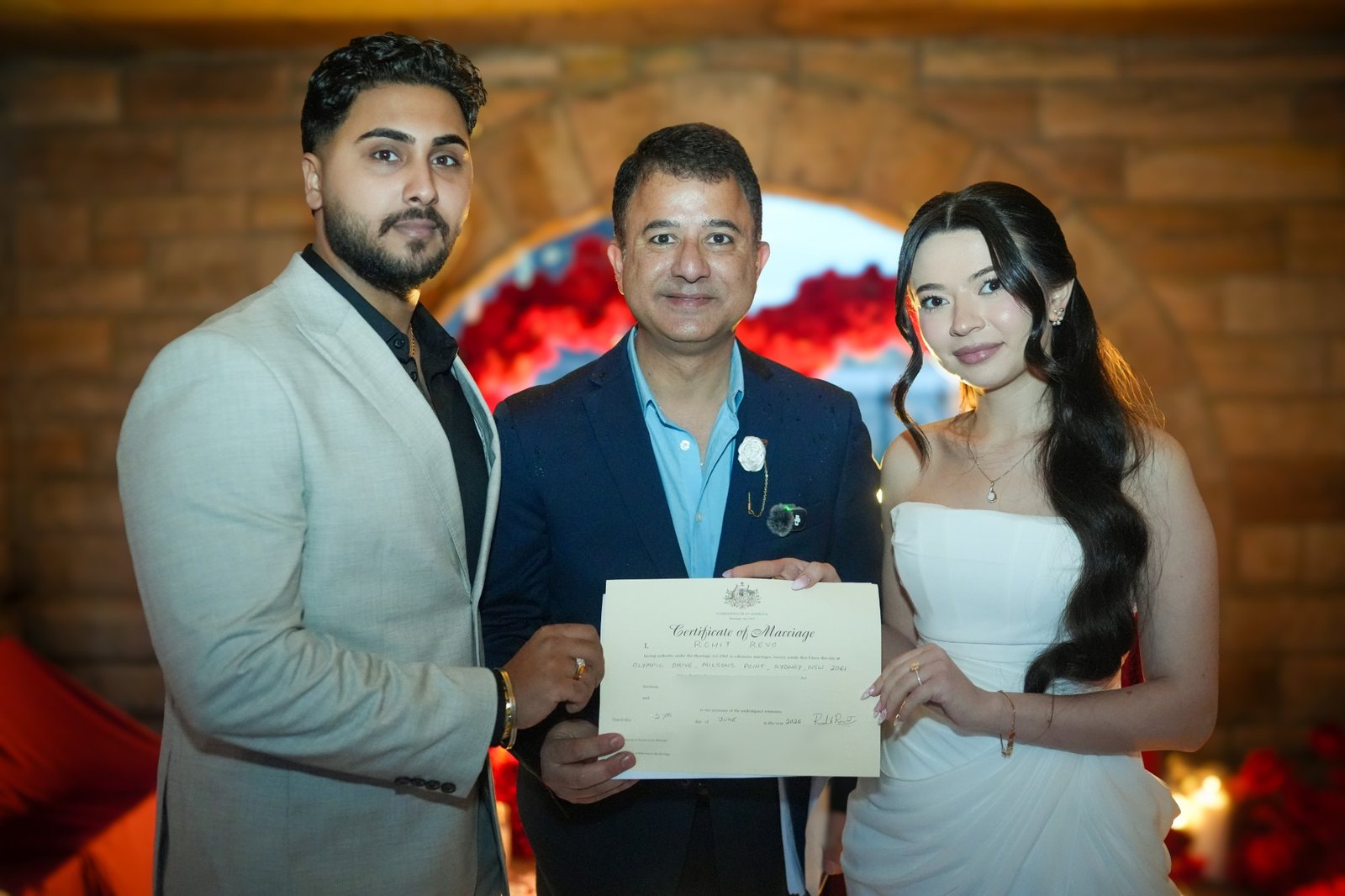
It also comes up constantly for legals-only and court-style ceremonies, where couples assume the short legal version has to be cold and English-only. It doesn't. Fifteen minutes in a language your parents understand is worth far more than fifteen minutes they sit through.
Frequently asked questions
What languages can the ceremony be conducted in?
I personally conduct ceremonies in English, Hindi and Punjabi, or any blend of the three. For other languages, elements of the ceremony can be delivered in a second language as an add-on arranged in advance.
Does a bilingual ceremony take twice as long?
No. It isn't translated line by line — that would double the length and halve the warmth. Each section is written to land once, with the key moments carried in both languages, so it runs to a normal twenty to thirty minutes.
Do the legal words have to be said in English?
Yes. The Marriage Act 1961 sets out specific wording that must be spoken, and that part is in English. Everything around it — the story, the vows, the blessings — can be in Hindi, Punjabi or both.
What if only one side of the family speaks Hindi or Punjabi?
That's the most common situation of all, and exactly what this is designed for. The structure includes both sides throughout, rather than leaving one waiting for a translation.
How much does a bilingual ceremony cost?
Hindi, Punjabi and English are included in my standard packages at no extra cost. Elements in another language, arranged through an interpreter or reader, start from $200.
Want both families to follow every word?
Tell me who's coming and which languages they're comfortable in — I'll show you how the ceremony would be structured.
Start the Conversation